Water supply and drainage engineering is the core supporting system of construction and municipal projects. The selection of pipes and their connection methods directly determine the stability, service life, and operation and maintenance costs of the system. Different scenarios have distinct requirements for the pressure resistance, corrosion resistance, and aging resistance of pipes, and the rationality of connection processes is the key to avoiding hidden dangers such as leakage and pipe burst. Combining engineering practices, this article sorts out the principles of pipe selection and mainstream connection methods for water supply and drainage engineering, providing a reference for project design and construction.
1.Principles of Pipe Selection for Water Supply and Drainage Engineering
(1)Match Pipe Materials to Usage Scenarios
For indoor building water supply and drainage, PPR pipes and UPVC pipes are preferred. PPR pipes feature high temperature resistance, hygiene, and environmental friendliness, complying with drinking water transportation standards and suitable for hot water supply systems. UPVC pipes are cost-effective and corrosion-resistant, widely used in indoor drainage and rainwater pipelines.
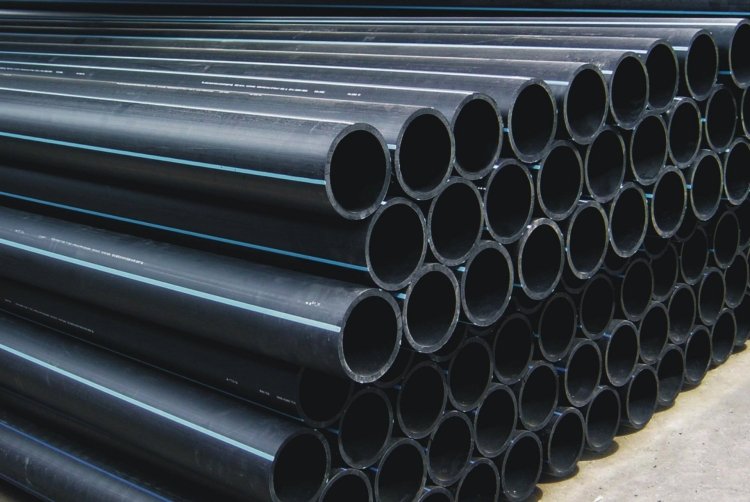
Municipal water supply and drainage projects mostly adopt HDPE pipes and ductile iron pipes. HDPE pipes have excellent flexibility and strong resistance to geological settlement, ideal for long-distance underground water transmission and sewage discharge. Ductile iron pipes boast high pressure ratings and superior mechanical strength, commonly applied in high-pressure water supply networks on municipal trunk roads.
For industrial water supply and drainage scenarios, pipes should be selected according to the transported medium. FRP glass fiber reinforced plastic sand pipes are the top choice for chemical wastewater transportation, while stainless steel pipes are suitable for strong acid and alkali media, ensuring the pipes meet the required chemical corrosion resistance standards.
(2)Select Pipes Based on Key Performance Parameters
Pipe selection should focus on three core indicators: pressure rating, ring stiffness, and temperature resistance range. Water supply pipes need to have a pressure rating of ≥1.0MPa; for secondary water supply in high-rise buildings, the pressure rating should be increased to above 1.6MPa. Underground drainage pipes require a ring stiffness of ≥8kN/m² to resist soil loads and ground settlement impacts. Hot water pipes should be made of materials with temperature resistance ≥70℃, such as PPR hot water pipes and stainless steel pipes.
Meanwhile, pipes for drinking water transportation must comply with safety standards such as NSF/ANSI 61 and GB/T 17219 to prevent the leaching of harmful substances like heavy metals.
2.Mainstream Connection Methods for Water Supply and Drainage Engineering
(1)Hot Melt Connection: Suitable for Plastic Pipes
Hot melt connection is the mainstream process for PPR pipes and HDPE pipes, divided into hot melt butt welding and hot melt socket welding. Hot melt butt welding is applicable to large-diameter pipes; it heats the pipe ends to melting, then presses and butt-joints them to form an integrated structure, featuring high connection strength and good sealing performance. Hot melt socket welding is mostly used for small-diameter PPR pipes, with simple operation and suitability for indoor water supply and drainage construction.
The key to this process is controlling the heating temperature and time, avoiding pipe deformation caused by over-melting or leakage due to insufficient melting.
(2)Solvent Cement Bonding: Suitable for UPVC Drainage Pipes
UPVC drainage pipes and rainwater pipes generally adopt solvent cement bonding. Special PVC glue is used to dissolve the surfaces of pipe and fitting interfaces, which form a firm connection after curing. During construction, ensure the interfaces are clean and dry, apply the glue evenly, insert and let it stand for curing to guarantee connection tightness.
This connection method is low-cost and efficient, but it is not suitable for high-pressure water supply systems and should be avoided in high-temperature environments.
(3)Mechanical Connection: Suitable for Metal and Composite Pipes
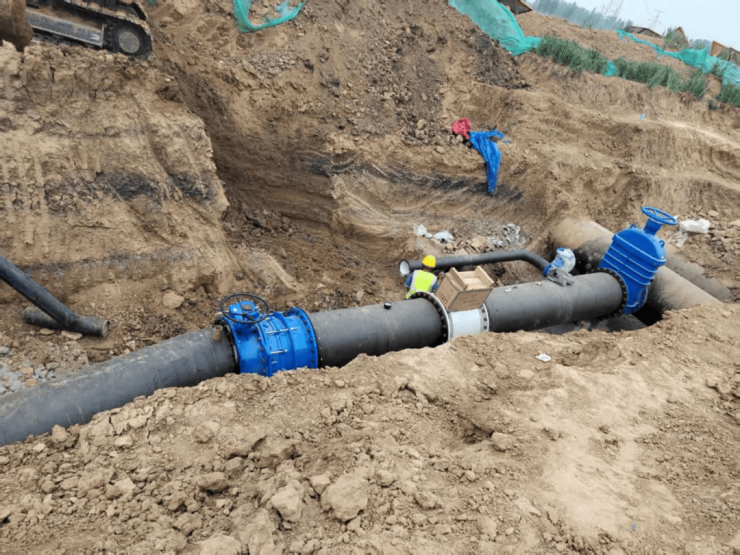
Ductile iron pipes, steel pipes, and stainless steel pipes often use mechanical connection methods, including flange connection, clamp connection, and threaded connection. Flange connection has excellent sealing performance, suitable for connecting large-diameter pipes and equipment, and facilitating later disassembly and maintenance. Clamp connection enables quick installation without welding, ideal for fire water supply, municipal sewage discharge, and other scenarios. Threaded connection is mostly used for small-diameter metal pipes, with simple operation, but proper sealing treatment of the threads is required
(4)Rubber Ring Sealed Socket Connection: Suitable for Large-Diameter Underground Pipes
Large-diameter underground pipes such as HDPE double-wall corrugated pipes and reinforced concrete drainage pipes usually adopt rubber ring sealed socket connection. The elastic deformation of the rubber ring is used to fill the interface gap, achieving a sealed and waterproof effect. At the same time, it has a certain ability to resist settlement and earthquake, adapting to the complex working conditions of municipal underground drainage projects.
 3.Notes on Pipe Selection and Connection
Pipe selection should balance cost-effectiveness and scenario adaptability, avoiding blind pursuit of high-priced pipes or the selection of low-cost and inferior products. Connection processes must strictly follow the construction specifications provided by pipe manufacturers; mixing connection methods for different material pipes is prohibited.
After construction, hydrostatic testing or water tightness testing should be carried out. The hydrostatic test pressure for water supply pipes is 1.5 times the working pressure, and the water tightness test for drainage pipes should ensure no leakage within 24 hours, so as to guarantee the safe operation of the system.
Post time: Jan-06-2026
