In B2B procurement scenarios such as municipal water supply and drainage, industrial fluid transportation, agricultural irrigation, and gas pipeline networks, HDPE pipes have become the preferred alternative to traditional pipes due to their excellent impact resistance, strong corrosion resistance, good flexibility, and long service life. However, HDPE pipes from different manufacturers vary greatly in raw material grades, process precision, and certification compliance. Blindly purchasing low-priced products can easily lead to problems like pipe cracking, leakage, and insufficient pressure resistance, laying long-term hidden dangers for engineering projects. As B2B buyers, you need to focus on four core dimensions—compliance certification, raw material quality, key performance parameters, and supplier service capabilities—to accurately select products that meet project requirements.
I. Verify Compliance Certifications to Match Scenario and Regional Standards
Compliance certification is a mandatory threshold for HDPE pipes to enter engineering projects, and it must be strictly checked according to application scenarios and target markets.
HDPE pipes used for drinking water transportation must pass NSF/ANSI 61 certification to ensure that no harmful substances such as heavy metals and plasticizers leach out during long-term use, meeting drinking water safety standards. For gas transportation scenarios, it is necessary to additionally confirm that the product has ISO 14696 certification for gas-specific use, while complying with special requirements like antistatic properties and aging resistance. For municipal engineering and export projects, verification of the internationally recognized ISO 4427 standard certification is required. The European market also needs supplementary CE certification, and domestic projects must comply with the national standard GB/T 13663, avoiding project acceptance obstacles caused by lack of certifications.
2.Distinguish Raw Material Quality to Differentiate Virgin and Recycled Materials
The performance of HDPE pipes is fundamentally determined by raw material quality. Most low-priced and inferior products on the market are made of recycled materials, which have fatal flaws such as poor impact resistance and easy aging.
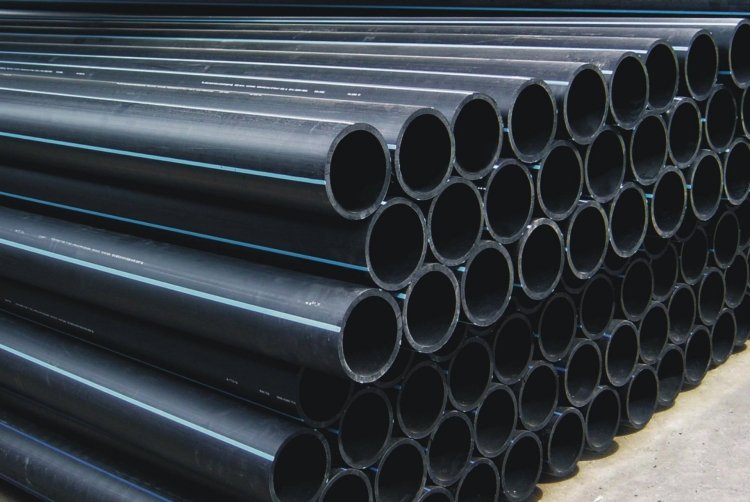
High-quality HDPE pipes are made of 100% virgin high-density polyethylene raw materials, mostly of PE100 grade (the highest grade currently available). The pipe surface shows a uniform black or blue color with soft luster, free of defects like spots, bubbles, and delamination. The cut section is dense and flat without impurity particles. On the contrary, pipes made of recycled materials have dull and uneven color, prone to white marks when bent, and their environmental stress cracking resistance is greatly reduced, making them difficult to adapt to complex working conditions such as underground and outdoor installation. During procurement, you can require suppliers to provide raw material inspection reports, clearly indicating the raw material grade and purity, to control quality from the source.
3.Check Key Parameters to Adapt to Actual Project Working Conditions
In B2B procurement, it is necessary to accurately match the performance parameters of HDPE pipes according to specific engineering conditions, avoiding cost increases caused by “parameter redundancy” or failures caused by “insufficient parameters”.
The primary focus is on raw material grade. PE100-grade pipes have better pressure resistance and crack resistance than PE80-grade pipes, making them more suitable for high-pressure water delivery and long-distance underground pipeline networks. Second is ring stiffness. Underground drainage pipes should choose products with ring stiffness ≥ SN8, which can resist soil pressure and ground loads to prevent pipe deformation. For overhead or mobile scenarios, it is crucial to check the elongation at break. High-quality HDPE pipes can achieve an elongation at break of more than 300%, with strong flexibility and resistance to breakage. In addition, for pipes transporting chemical media, it is necessary to confirm the chemical corrosion resistance of the pipes and ask suppliers to provide inspection reports on acid, alkali, and organic solvent resistance.

4.Evaluate Supplier Strength to Ensure Full-Process Services
The core of B2B procurement lies not only in products but also in suppliers’ supporting service capabilities, which directly affect project construction efficiency and later operation and maintenance.
Prioritize source manufacturers with large-scale production bases. Such enterprises have stable production processes and sufficient production capacity, which can meet the bulk supply needs of large-scale projects and offer greater bargaining space. Second, pay attention to suppliers’ technical support capabilities, such as whether they can provide customized specifications (e.g., large diameters, special wall thicknesses), construction guidance (e.g., training on hot-melt butt welding and electrofusion connection processes), and on-site testing services. Finally, verify after-sales service terms. High-quality suppliers will provide a product quality assurance commitment of more than 50 years, along with a complete return and exchange policy and damaged parts replacement service, solving worries after procurement.
In conclusion, when selecting HDPE pipes, B2B buyers should not only focus on price but also conduct a comprehensive evaluation from four dimensions: certification, raw materials, parameters, and services. Only by choosing suppliers with reliable quality and perfect services can the long-term stable operation of engineering projects be guaranteed, and the procurement goal of cost reduction and efficiency improvement be achieved.
Post time: Dec-30-2025
